
Austrians spent €12.3 billion online in the past year, and almost half of it went to shops based abroad. For a long time, many brands served Austrian customers from a distance: from a warehouse in another EU country, or with single parcels shipped straight from overseas.
2026 changes the math. Since 1 July, low-value parcels shipped into the EU from outside carry a €3 customs duty for each type of product inside. And since 1 October 2026, Austria has charged its own €2 parcel tax on the largest online retailers and marketplaces. Delivery speed, cost per parcel and customs exposure now all depend on where your stock sits.
In this post we look at what is happening in Austrian e-commerce, what it means for fulfillment and warehousing in Austria, and how to decide whether your products should be stored in the country.
The Austrian e-commerce market in numbers
Austria has just over 9 million people, and most of them shop online. According to the E-Commerce Study Austria 2026 by Handelsverband and KMU Forschung Austria, around 5.8 million Austrians shop online. Together they spent €12.3 billion, and 44% of that (€5.4 billion) was spent on a phone.
| Top online category in Austria | Annual online spend |
| Clothing and textiles | €2.4 billion |
| Electronics | €1.5 billion |
| Furniture and home | €1.0 billion |
Two more numbers matter for anyone planning warehousing in Austria:
Parcel volumes keep climbing. Austrian Post alone delivered 232 million parcels in Austria in 2025, up 3.5% on the year before. That is more than 25 parcels per resident.
47% of online spend goes to foreign shops. Austrian buyers are used to ordering from Germany and beyond, so a foreign brand is not a barrier. A slow or expensive delivery is.
Three trends shaping fulfillment in Austria
1. New costs on cross-border parcels. Since 1 July 2026, the EU charges a flat €3 duty on goods worth up to €150 shipped from outside the EU. It is charged per product type in the parcel, so five T-shirts cost €3, but T-shirts plus a watch cost €6 (European Commission). The rule is temporary until the small-parcel exemption ends for good in 2028. Brands that ship single orders from China, the UK or Switzerland now pay more per order. Goods imported in bulk into a warehouse inside the EU, for example in Austria, are cleared once and then delivered like any domestic parcel.
2. Austria’s own parcel tax. From 1 October 2026, online sellers whose Austrian mail-order sales topped €100 million in the previous year pay €2 per parcel. Marketplaces pay it for sales they facilitate, wherever the seller is based (Austrian Ministry of Finance). Around 16 big players are hit directly, including Amazon, Zalando and Temu. Smaller brands selling through their own shop are not charged, which gives them a price edge, as long as their own shipping costs stay low.
3. Buyers expect next-day delivery. Austrians compare every shop with the speed of the big marketplaces. Austrian Post handles most parcels, followed by DHL, DPD and GLS. Orders shipped from inside the country reach most addresses the next working day.
Warehousing in Austria vs. shipping from abroad
There are three common ways to serve Austrian customers. Each works, but for different businesses.
| Setup | Typical delivery to Austria | Customs per order | Best for |
| Ship each order from outside the EU (China, UK, Switzerland) | Several days to weeks | Yes: €3 EU duty per product type, plus import VAT and handling, on every parcel | Testing the market with very low volumes |
| Hub in another EU country (e.g. Germany, Netherlands) | 1–3 working days | No, goods already in the EU | Brands selling across many EU countries at once |
| Fulfillment center in Austria | Next working day for most addresses | No, goods are cleared once on bulk import into the EU | Brands where Austria is a core market, and a base for CEE and DACH |
A warehouse in Austria usually pays off when:
- Austria (or Austria plus neighbours like Germany, Slovakia, Hungary, Slovenia) is one of your top markets.
- You ship from outside the EU today and the new €3 duty is eating your margin.
- Your reviews mention slow delivery or customs surprises.
- Returns from Austrian customers travel too far and too slowly back to you.
- You compete with the big marketplaces and want their delivery speed without their new €2 parcel tax.
Selling from outside the EU? Austria as your EU warehouse
For brands based in Switzerland, the UK, the US or Asia, 2026 is the year an EU warehouse starts to pay off. Shipping each order from home now means EU duty, import VAT and handling on every single parcel, plus customs delays your customers notice.
With stock in an EU warehouse, the flow changes:
- You send goods to the EU in bulk, as one shipment.
- They are cleared through customs once, and duty and import VAT are paid on the whole shipment.
- From then on, every order ships as a domestic EU parcel: no customs at the door, no surprise fees for the buyer.
- Returns stay in the EU and go straight back into stock.
Austria is a good place for that warehouse. It sits in the middle of Europe, next to Germany, the EU’s largest e-commerce market, and close to Czechia, Slovakia, Hungary and Slovenia. Being German-speaking also makes it a natural base for the whole DACH region, including Switzerland.
Before you start, you will usually need an EORI number for customs and a VAT registration in the EU country where your stock sits. Requirements depend on your setup, so check them with a tax advisor.
How SMS Fulfillment handles fulfillment in Austria
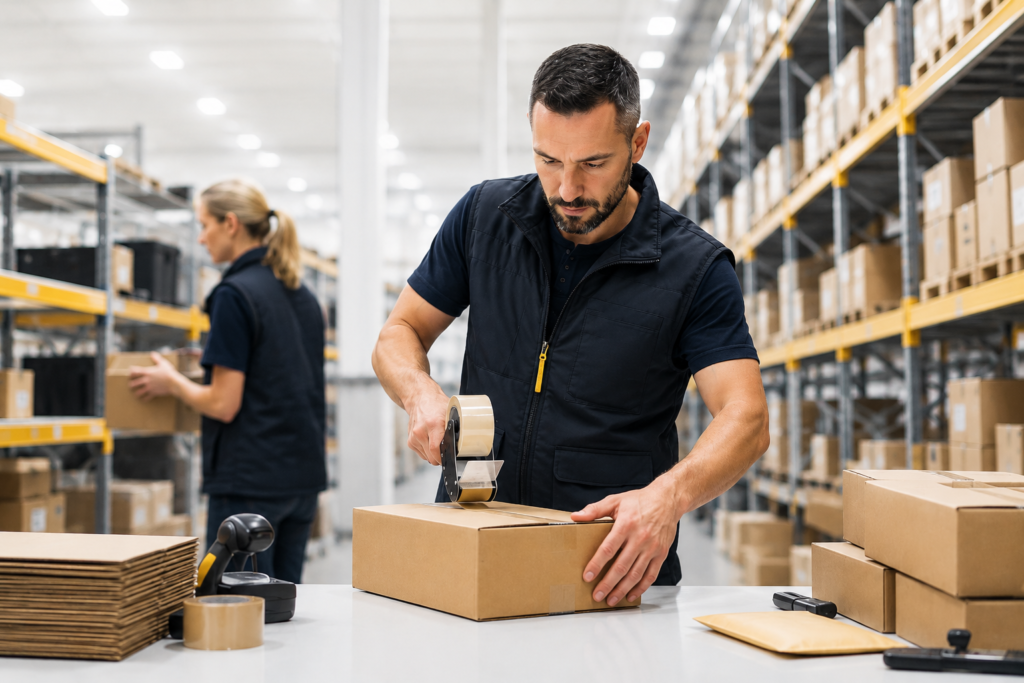
SMS Fulfillment runs two of its own fulfillment centers in Lower Austria, in Herzogenburg and Gerersdorf. Your stock sits in the country, so Austrian orders go out with domestic carriers and arrive fast. From the same base, we reach Germany, Switzerland and Central and Eastern Europe.
What you get:
- Warehousing in Austria, including climate-controlled storage, with no minimum storage quantity.
- Pick, pack and ship with two automated Kardex systems and 99.9% picking accuracy.
- Customs know-how from more than ten years of moving goods into the EU and Switzerland, including our own customs branch in Slovakia.
- Returns management inside Austria, so returned goods are checked and back in stock quickly.
- Easy Commerce, our fulfillment platform for orders, stock and shipments, connected to your shop, marketplaces and Amazon.
- A dedicated account manager and in-house IT support, with no minimum order quantity and no hidden fees.
Not sure if a warehouse in Austria is right for your volume? Tell us what you sell and where your customers are. You get a custom offer within 24 hours.
Get your Austria fulfillment offer
FAQ: fulfillment and warehousing in Austria
Do I need a warehouse in Austria to sell to Austrian customers? No. But if Austria is a key market, local stock means faster delivery, simpler returns and no customs charges on each order.
What is the Austrian parcel tax? From 1 October 2026, online sellers with more than €100 million in Austrian mail-order sales pay €2 per parcel. Most small and mid-sized brands are below that threshold, but sales through a large marketplace can be taxed via the marketplace.
How does the EU €3 duty affect me? It applies to goods up to €150 shipped into the EU from outside, at €3 per product type in each parcel. Storing goods in a fulfillment center inside the EU, such as in Austria, means you import in bulk and avoid paying it on every single order.
My company is outside the EU. Can I use a fulfillment center in Austria? Yes. You ship your goods in bulk, they are cleared into the EU once, and orders then go out as domestic EU parcels. We handle the import and customs clearance with you.
Which carriers deliver in Austria? Austrian Post is the largest, followed by DHL, DPD and GLS. A 3PL in Austria can combine several of them per destination and service level.
Can I serve Germany and Eastern Europe from Austria? Yes. Lower Austria is close to Vienna and the main routes to Germany, Czechia, Slovakia and Hungary.